Sniper Battle: 3D War Shooter
- 4.6
- Rating
- 1.00M
- Installs
- Free
- Price
 Analysis by App-foxy
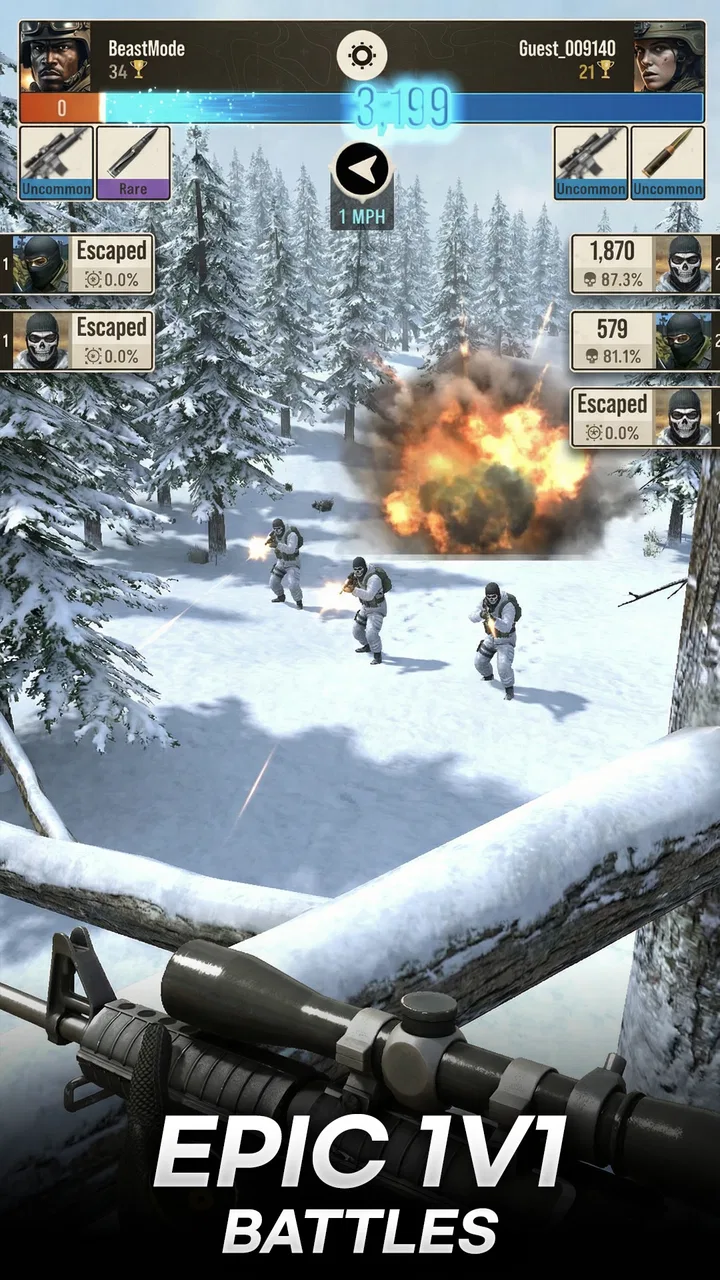
Sniper Battle: 3D War Shooter is the kind of action game I can understand within seconds: find a target, line up the shot, and try to outthink another player before they do the same to me. Its focus is real-time one-on-one sniper duels, so it does not ask me to learn a sprawling campaign or manage a large squad. That narrow idea is also its strongest identity. When I want a short, tense contest rather than a long match, it gives me a clear reason to play.
After spending time with it, I see a game aimed at people who enjoy careful aiming more than constant running and shooting. The developer, HypGames., keeps the premise direct, while the action category makes sense for its competitive pressure and quick decisions. It is free to start, carries a Teen age rating, and has reached more than half a million installs. Those details make it easy to try, but the real question is whether a player can comfortably handle its visual focus, timing demands, and competitive format.
How clearly the game communicates its action
I find that a game’s clarity matters most when a match gets tense: it should help me distinguish the goal from the surrounding visual detail without making me stop and decode the screen. Here, the one-on-one setup gives me a narrow task, but the small aiming focus can still be demanding. That leads into a closer look at how physical comfort, sensory needs, and the place where I play affect the experience.
You May Also Like

 Blood Strike: 2.5 Anniversary
Blood Strike’s Loadouts Turn Every Drop Into a Tactical Gamble
A close look at Blood Strike’s custom loadouts: how fast access to signature weapons reshapes its battle royale rhythm, rewards preparation, and narrows the gap between fights.

 Pandora - Music & Podcasts
Pandora’s Music Is Easy to Start, but Harder to Recover
Pandora’s strength is its low-effort path from a seed to a station. Its weak spot is how much confidence it asks you to place in connection, setup, and quiet recovery.

 8 Ball Pool
 Is Built on Rivalries, Rematches, and Routine
A close look at the rivalries, rematches, shared routines, and unanswered safety questions that turn a quick pool match into a persistent mobile community.

 Samsung Music
’s Quiet Strength Is Playing What You Already Own
Its reach comes less from spectacle than from dependable access to a personal library. That simplicity is both the app’s strongest retention engine and its ceiling.

 AccuWeather: Weather Radar
AccuWeather Review: A Quick, Clear Forecast for Everyday Decisions
For everyday plans, the best forecast is the one you can understand quickly. AccuWeather makes rain timing, radar, and local conditions easy to act on, with a few trade-offs.

 Hill Climb Racing
Why Hill Climb Racing Still Turns Crashes Into One More Run
A tiny car, a bumpy hill and one more upgrade: Hill Climb Racing keeps resurfacing because its simple chaos makes every near-miss feel personal.
More From Our News Desk
View All News


Readable goals and a focused interface
The best thing about the presentation is that the central task is obvious. I am not searching through a maze of objectives before a duel begins. The game’s identity is built around the scope, the target, and the opponent, which gives each round an immediately understandable purpose. For a new player, that clarity matters because the first few moments in a competitive game can otherwise be spent guessing what to tap or where to look.
That simplicity also helps when I am playing in a brief session. I can approach it as a compact reaction-and-precision challenge instead of committing to a large progression system. The store rating sits at a strong 4.7 average from roughly eight thousand ratings, and I can see why the focused concept is appealing: the game explains itself through the action rather than through a complicated set of rules.
Still, readable does not automatically mean effortless. A sniper duel places most of the player’s attention on a small visual area. The target may be easy to understand in principle, but identifying the important detail quickly can be harder for someone with reduced vision, visual fatigue, or difficulty separating a character from a busy background. I would recommend trying a few matches before deciding whether the contrast and scale feel comfortable on a particular phone.
Navigation that suits short sessions
For everyday use, the compact structure is more approachable than a game that surrounds a simple match with many layers of menus. I can imagine opening it while waiting for an appointment, taking a few turns during a commute, or playing a short session after work without needing to remember a complex control scheme. That makes the game a reasonable fit for players who want a quick competitive distraction rather than a hobby that demands a long uninterrupted block of time.
One useful habit is to treat the opening moments of a round as an orientation check. Before concentrating on the opponent, I look at where the aiming area sits, where any match information appears, and how much of the screen is occupied by controls. This is especially helpful for anyone who uses a larger display, a smaller phone, or a device with a different aspect ratio. Familiarity with the layout reduces the need to search visually while the duel is already underway.
The same focused design can feel restrictive for players who prefer exploration, story, or a broad selection of activities. This is not a substitute for a traditional campaign shooter, a tactical team game, or a relaxed puzzle game. Its navigation is useful because it leads me toward one specific activity, not because it offers a large range of ways to play.
Why the one-on-one format matters
A direct duel can be easier to follow than a crowded battlefield. There are fewer competing players, fewer simultaneous threats, and less need to monitor several directions at once. For someone who finds large multiplayer scenes overwhelming, that limited scope may make the action more manageable. I can focus on one opponent and one decision instead of scanning a whole arena.
There is a trade-off, though. In a one-on-one match, every mistake feels exposed. A missed shot or delayed reaction cannot be hidden inside team activity, and that pressure may be uncomfortable for players who prefer cooperative games or forgiving practice modes. The format rewards concentration, but it also makes fatigue more noticeable. If my attention is already low, I am more likely to rush a shot and lose the benefit of the game’s slower, deliberate premise.
Physical, sensory, and situational access
I judge access not only by whether I can start a duel, but by whether I can keep playing comfortably and safely in ordinary settings. Precise touch input and sustained visual attention make posture, lighting, interruptions, and fatigue especially relevant here. In the next section, I’ll consider practical ways to assess that fit and when a slower or less visually demanding game may be the better choice.
Motor demands behind a simple shot
At first glance, aiming and firing seem like small actions, but a sniper duel can ask for several kinds of control at once: steady touch, accurate placement, quick adjustment, and the ability to repeat those movements under pressure. Players with limited finger mobility, tremors, joint pain, or difficulty making precise taps may find the core interaction demanding even if the rest of the interface looks simple.
I find that the most practical approach is to hold the phone in a stable position and avoid playing while walking or standing in a crowded place. A supported posture gives the hand less work to do and makes small corrections more deliberate. It also reduces the temptation to compensate for an awkward grip by dragging too aggressively. This is not a feature of the game, but it is a meaningful difference in how accessible the same duel can feel from one situation to another.
Players who use an alternative input method should be cautious about assuming that every action will translate neatly. A game built around aiming precision may not feel equally responsive through every external control setup. I would test the basic interaction early, rather than investing time or purchases before knowing whether the controls suit my movement needs.
Visual attention and sensory load
The game’s sniper theme naturally puts visual precision at the center. That can work well for players who enjoy concentrating on a small target, but it may be tiring for people who experience eye strain, light sensitivity, or difficulty tracking subtle changes. Short sessions are a sensible way to evaluate it. I would also avoid judging the game only in ideal indoor lighting, because glare, reflections, and a dim screen can change how easily the target and interface stand out.
Sound can influence the feel of a duel, but I would not rely on audio alone to understand what is happening. Anyone who plays with hearing loss, muted audio, or a noisy background should pay attention to whether the visual presentation gives enough information without sound. Conversely, players sensitive to sharp effects may prefer a quieter environment or lower device volume. The important point is that the game’s central challenge remains visual and timing-based, so sensory comfort has a direct effect on performance.
A useful routine is to adjust the device before a serious match rather than during one. I check brightness, clean the screen, silence distracting notifications, and use headphones only when they make the situation more comfortable. These small steps do not change the game’s mechanics, but they can prevent avoidable mistakes caused by glare, interruptions, or an uncomfortable listening environment.
Playing in real-life situations
Sniper Battle fits best into a stable setting where I can hold the phone securely and give the match my attention. A quiet break at home, a seated wait, or a short rest between tasks makes more sense than playing while crossing a street, riding a bicycle, or moving through a busy station. The need to watch a target closely means that this is not a good game to treat as background entertainment.
That situational requirement is easy to overlook because matches appear compact. A short round can still demand complete attention for its duration, and the competitive format gives me little room to pause mentally. If I am interrupted often, have limited time to react, or need to keep awareness of people around me, a slower single-player game would be a safer and more comfortable choice.
The Teen content rating is also relevant to context. I would not present it as a universal choice for young children, particularly when the player is sensitive to competitive pressure or shooting themes. For older players, the rating provides a useful reminder to consider the intended tone before handing the phone to someone else.
Where the free entry helps and where it complicates decisions
Being free makes experimentation straightforward. I can install it, test the aiming feel, and decide whether the visual and physical demands suit me without paying at the door. That is valuable for accessibility because comfort varies widely between players and devices. A game that feels easy for one person may be tiring or frustrating for another.
There are in-app purchases ranging from under a dollar to nearly one hundred dollars per item. I would treat that range as a reason to decide on a personal spending boundary before playing regularly. Competitive games can make a player feel pressure to keep up, and that pressure is particularly unhelpful when someone is still working out whether the controls, pace, or presentation are comfortable. The free starting point is a benefit, but it does not remove the need for careful purchase decisions.
Remaining barriers for different players
The biggest barrier is not learning the premise; it is performing the precise visual and motor task consistently. Players who need slower pacing, larger targets, strong contrast, or generous aiming assistance may find a one-on-one sniper format less accommodating than a turn-based game or a shooter with adjustable difficulty. I would not choose this as my first option for someone who wants to explore accessibility settings before committing to a fast competitive interaction.
Another barrier is emotional rather than physical. Losing in a direct duel can feel personal because the result is immediately tied to my timing and accuracy. Some players enjoy that intensity, while others need a gentler learning curve. I would recommend it to someone who can treat early losses as practice, but I would steer a highly competitive or easily frustrated player toward a less confrontational alternative.
The game is also a weaker fit for people who need uninterrupted access to a story or a predictable offline routine. Its appeal comes from the duel itself, so the experience is less suitable if I want a game that can be enjoyed passively, at my own pace, or without focusing on another player’s actions. That distinction is more important than the attractive install count or the high average rating.
Version, device expectations, and practical testing
The current version is 1.02.00, and the game supports devices running Android 6.0 or later. That broad operating-system requirement makes it available to many older Android users, although compatibility on paper does not guarantee that every phone will offer the same comfort or responsiveness. Screen size, touch sensitivity, performance, and battery condition can all change how precise aiming feels.
My recommendation is to use the first session as a practical test rather than immediately judging the game by its competitive results. Check whether targets remain legible, whether a comfortable grip allows accurate movement, and whether the pace leaves enough time to understand what happened after a missed shot. If those basics work, the focused design can become genuinely enjoyable. If they do not, a different action game with slower timing or more adjustable presentation will probably serve you better.
My inclusive verdict
I like Sniper Battle: 3D War Shooter most when I want a concentrated, visually driven contest that can fit into a short break. Its one-on-one structure is easier to follow than a chaotic team battlefield, and its central objective is clear enough for new players to grasp quickly. The strong 4.7 average from around eight thousand ratings suggests that this direct approach has connected with many players, while more than five hundred thousand installs show that it has found a substantial audience.
My recommendation comes with a clear condition: you should be comfortable with precise touch input, close visual attention, and the pressure of a direct competitive exchange. Players with motor or vision limitations may find the core challenge tiring, and anyone needing extensive control customization should test the game carefully before spending money. The same simplicity that makes it approachable can also leave fewer alternatives when the aiming task itself is the problem.
For me, the fairest conclusion is that this is an accessible idea, but not automatically an accessible experience for everyone. It gives players a clean route into short sniper duels, yet the central mechanic remains demanding. I would recommend trying it in a seated, well-lit setting, setting a spending limit, and stopping when visual or hand fatigue appears. If that setup makes the matches feel clear and manageable, HypGames.’ action game is a sharp little competitive option. If I need slower pacing, broader sensory support, or a less stressful way to play, I would choose another genre instead.
FAQs for Sniper Battle: 3D War Shooter
01What are the main features of Sniper Battle: 3D War Shooter?
Sniper Battle: 3D War Shooter offers a thrilling first-person shooting experience with realistic 3D graphics. Players can engage in various missions, utilize a wide array of sniper rifles, and experience dynamic weather conditions. The game also features multiplayer modes for competitive play and in-game events to keep the gameplay fresh and exciting.
02Is Sniper Battle: 3D War Shooter free to play?
Yes, Sniper Battle: 3D War Shooter is free to download and play. However, it does offer in-app purchases that allow players to buy additional weapons, upgrades, and cosmetic items. These purchases can enhance your gameplay experience but are not necessary to enjoy the game fully.
03What are the system requirements for Sniper Battle: 3D War Shooter?
To run Sniper Battle: 3D War Shooter smoothly, Android devices should have at least 2GB of RAM and be running on Android 5.0 or higher. For iOS devices, iOS 10.0 or later is required. A stable internet connection is also recommended for accessing multiplayer features and updates.
04Does Sniper Battle: 3D War Shooter require an internet connection?
While Sniper Battle: 3D War Shooter can be played offline for single-player missions, an internet connection is necessary for accessing multiplayer modes, downloading updates, and participating in special events. Playing online also ensures you have access to the latest content and features.
05How can I improve my skills in Sniper Battle: 3D War Shooter?
Improving your skills in Sniper Battle: 3D War Shooter involves regular practice and familiarizing yourself with different weapons and maps. Joining online communities and forums can offer strategic tips and advice. Additionally, focusing on accuracy and learning to anticipate enemy movements can greatly enhance your performance.
Pros
- Realistic graphics enhance immersion.
- Wide variety of weapons to choose from.
- Engaging multiplayer mode.
- Intuitive controls simplify gameplay.
- Regular updates with new content.
Cons
- Frequent ads can interrupt gameplay.
- In-app purchases may be costly.
- Requires a stable internet connection.
- Battery consumption is relatively high.
- Limited offline play options.

Sniper Battle: 3D War Shooter
Gallery